Every UPS buyer faces this choice. The difference goes far deeper than size and price — it determines how your system performs under real-world stress, how long it lasts, and whether it can handle the specific demands of your application.
Table of Contents
- How each technology actually works
- Key technical differences explained
- Full head-to-head comparison table
- Where low-frequency UPS excels
- Where high-frequency UPS excels
- Which to choose by industry and application
- Total cost of ownership: a realistic comparison
- Decision guide: 5 questions to ask before you choose
1. How Each Technology Actually Works
The names “high frequency” and “low frequency” refer to the switching frequency of the internal power conversion components — not the output frequency of the UPS, which is always 50Hz or 60Hz regardless of type. Understanding this distinction is the foundation of choosing correctly.
Low-Frequency UPS (LF UPS)
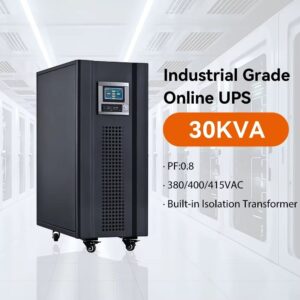
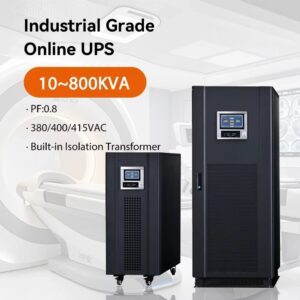
A low-frequency UPS uses a large, line-frequency transformer as the core of its power conversion circuit. The transformer operates at mains frequency — 50Hz or 60Hz — which is why these systems are also called transformer-based o industrial-frequency UPS.
The architecture typically involves three stages:
- Rectifier stage: Converts incoming AC mains power to DC, using SCR (Silicon Controlled Rectifier) or thyristor-based technology. These components are extremely robust and tolerate high surge currents without damage.
- Battery/DC bus: The DC bus connects directly to the battery bank. During a mains failure, the battery discharges through the inverter with no switching delay.
- Inverter stage with output transformer: The inverter produces a regulated AC output, which passes through a low-frequency isolation transformer before reaching the load. This transformer provides galvanic isolation, voltage regulation, and significant protection against electrical noise and faults.
The isolation transformer is the defining feature. It physically separates the input and output circuits, which has profound implications for load protection, fault tolerance, and the ability to handle non-linear and reactive loads.
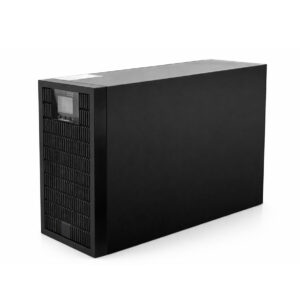
Low-Frequency UPS
High-Frequency UPS (HF UPS)
A high-frequency UPS replaces the line-frequency transformer with fast-switching semiconductor devices — typically IGBTs (Insulated Gate Bipolar Transistors) — that operate in the range of 10–20 kHz or higher. Some designs are entirely transformerless; others use a small high-frequency transformer for isolation, which is far lighter than a line-frequency equivalent.
The architecture typically involves:
- Active front-end (AFE) rectifier: Uses IGBT switching to convert AC to DC with high power factor correction (PFC), typically achieving input PF of 0.99 or better. This dramatically reduces harmonic distortion fed back to the supply.
- DC bus and battery interface: The battery connects via a DC-DC converter that manages charge/discharge cycles efficiently. In some designs, the battery bus voltage is lower than the DC bus, enabling the use of smaller battery strings.
- IGBT inverter: Produces output AC using pulse-width modulation (PWM) at high frequency, then filtered to a clean 50/60Hz sine wave. Without a line-frequency output transformer, the inverter output goes directly — or through a small HF transformer — to the load.
💡 What “high frequency” actually means for the buyer
The high switching frequency allows the use of much smaller passive components (inductors, capacitors, transformers), which is why HF UPS systems are typically 30–50% lighter and smaller than equivalent LF systems. It also enables faster response to load changes and more precise output voltage regulation. The trade-off is that high-speed IGBT switching components are more sensitive to electrical stress than the robust thyristors used in LF designs. For a deeper look at how IGBTs work inside a UPS, see our article on IGBT Technology in UPS Systems.
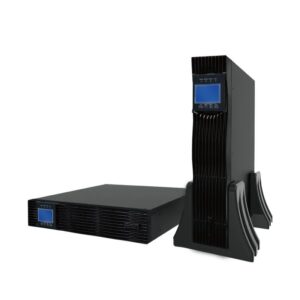
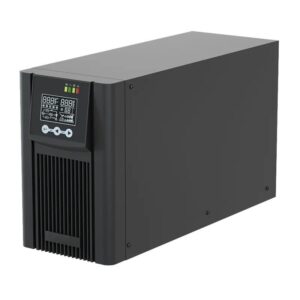
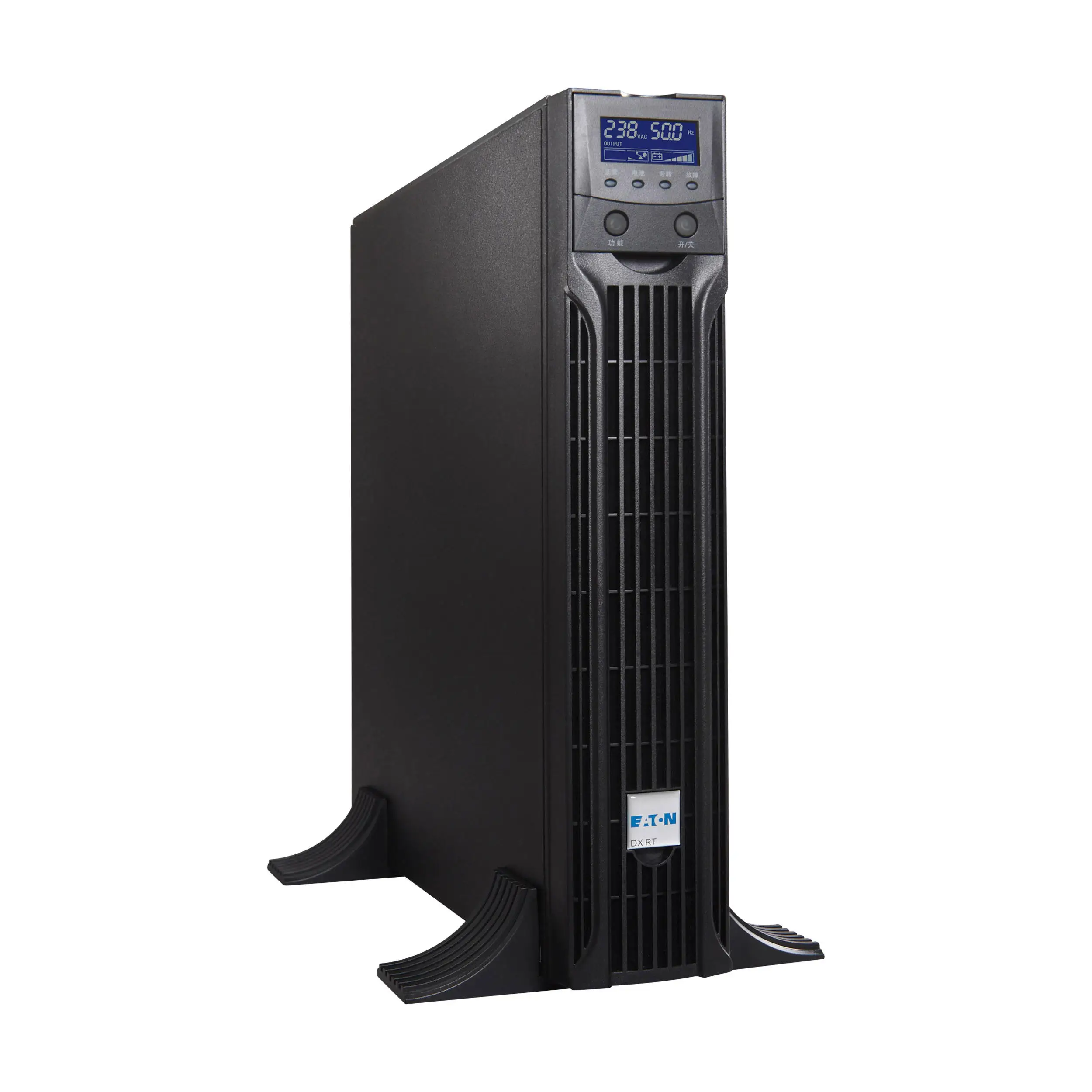
High-Frequency UPS
2. Key Technical Differences Explained
Overload and short-circuit capability
This is the most practically important difference for industrial buyers.
A low-frequency UPS — by virtue of its robust thyristor rectifier and output transformer — can typically handle overloads of 150% for 60 seconds and short-circuit currents of 300% or more for several cycles. When a connected motor starts, a downstream breaker trips, or a fault occurs, the LF UPS doesn’t flinch. The transformer naturally limits the rate of current rise (di/dt), protecting both the UPS and downstream equipment.
A high-frequency UPS uses IGBTs, which are far more sensitive to overcurrent. Most HF systems are rated for overloads of 125% for 60 seconds and short-circuit currents of 125–150% before transferring to bypass. Exceed those limits and the IGBTs are at risk of failure. This is not a flaw — it’s a fundamental characteristic of the semiconductor technology.
⚠️ Why this matters in practice
Motor starting currents, transformer inrush, and downstream fault clearing all generate current spikes well above the rated load. In a factory or industrial facility, these events happen routinely. An LF UPS absorbs them without issue. An HF UPS protecting the same load may transfer to bypass repeatedly — or in a worst case, sustain IGBT damage — if the load profile wasn’t carefully assessed at the design stage.
Input power factor and harmonic distortion
Traditional LF UPS systems with thyristor rectifiers draw current in pulses, generating significant input harmonic distortion — typically 25–30% Total Harmonic Distortion (THDi). This can interfere with other sensitive equipment on the same supply and may require input filters or harmonic mitigation in installations where power quality is tightly regulated.
Modern HF UPS systems with active front-end (AFE) rectifiers achieve input THDi of less than 3% and input power factors of 0.99 or better. This means the UPS draws near-sinusoidal current from the supply, placing minimal harmonic stress on the building’s electrical infrastructure and connected generator.
Note: Modern LF UPS designs increasingly incorporate active rectifier stages that significantly reduce their harmonic footprint. The “LF = high harmonics” assumption is less universally true than it once was — always check the specific product datasheet.
Eficiencia
Line-frequency transformers have inherent core losses that are present whenever the UPS is energised — regardless of load. This is why traditional LF UPS systems typically achieve efficiencies of 88–93% at full load, dropping further at partial loads.
HF UPS systems, by eliminating the line-frequency transformer losses, typically achieve efficiencies of 94–97% at full load, and maintain good efficiency at partial loads (60–80% of rated). Over the lifetime of a large UPS installation, this efficiency difference translates to meaningful energy cost savings — a topic explored in depth in our article on UPS System Efficiency.
For a 100 kVA UPS running at 80% load, a 4% efficiency improvement translates to approximately 28,000 kWh saved per year — a significant operational cost difference at scale.
Galvanic isolation
The output transformer in an LF UPS provides galvanic isolation — a physical electrical separation between the input supply and the output load. This has several important consequences:
- Common-mode noise and transients on the supply are blocked from reaching the load
- Ground fault currents on the output side are contained without affecting the input
- The UPS can support different earthing configurations (TN-S, TT, IT) independently on input and output
- Medical-grade isolation requirements (IEC 60364-7-710) are more easily met
HF UPS systems without a line-frequency output transformer do not provide this isolation by default. Some designs include a high-frequency isolation transformer, but its characteristics differ from a line-frequency unit. For medical, petrochemical, and certain manufacturing applications where isolation is a regulatory or safety requirement, this distinction can be decisive.
Size, weight, and installation footprint
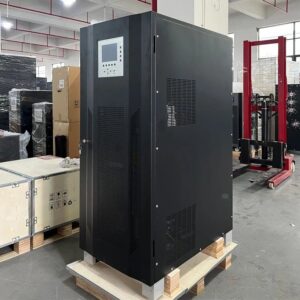
The line-frequency transformer in an LF UPS can account for 30–50% of the unit’s total weight. A 100 kVA LF UPS may weigh 400–700 kg. The equivalent HF UPS typically weighs 150–250 kg. This difference has direct implications for floor loading, transportation, installation logistics, and the practicality of rack-mounting.
For installations where floor space is at a premium — data centers, telecommunications rooms, modular containerised power systems — the compact form factor of HF UPS is a genuine advantage. For industrial switchrooms and substations where floor loading is not a constraint, the size of an LF unit is rarely a deciding factor.
3. Full Head-to-Head Comparison
| Parámetro | Low-Frequency UPS | High-Frequency UPS |
|---|---|---|
| Core technology | Thyristor/SCR rectifier + line-frequency transformer | IGBT switching at 10–20 kHz, transformerless or small HF transformer |
| Typical efficiency | 88–93% at full load | 94–97% at full load |
| Capacidad de sobrecarga | 150% / 60s; 300%+ short circuit | 125% / 60s; 125–150% short circuit |
| Input harmonic distortion (THDi) | 25–30% (thyristor); <5% (active rectifier) | <3% (AFE rectifier) |
| Input power factor | 0.8–0.9 (thyristor); ~0.99 (active rectifier) | ~0.99 |
| Galvanic isolation | Yes — standard | Not standard (optional HF transformer) |
| Weight (100 kVA example) | 400–700 kg | 150–250 kg |
| Size / footprint | Large | Compact |
| Capital cost | Higher | Lower |
| Service life | 15–20+ years | 10–15 years |
| Maintainability | Simpler components; field-repairable | Complex PCBs; often board-level replacement |
| Motor / reactive load tolerance | Excellent | Moderate — requires careful sizing |
| Generator compatibility | Good — tolerant of generator instability | Good with AFE; older designs may have issues |
| Rack-mountable | No (floor-standing only above ~10 kVA) | Yes — available in rack-mount formats |
| Best suited for | Industrial, manufacturing, medical, utilities, oil & gas | Data centers, IT rooms, offices, telecom |
4. Where Low-Frequency UPS Excels
Heavy industrial and manufacturing environments
Factory floors are electrically hostile environments. Motor drives, variable-frequency drives (VFDs), welding equipment, CNC machines, and compressors all generate voltage spikes, harmonic currents, and high inrush demands. The robust transformer-based architecture of an LF UPS handles these demands without complaint. Its high overload and short-circuit tolerance means it can clear downstream faults without tripping to bypass — maintaining power continuity for the critical control systems it protects. For a broader look at protecting manufacturing operations, see our article on Soluciones de energía de emergencia para plantas de fabricación.
Medical facilities requiring galvanic isolation
Hospitals, surgical suites, and diagnostic imaging centres operate under strict electrical safety regulations. IEC 60364-7-710 requires medical IT systems (isolated power systems) in areas where patients may be in contact with live parts. An LF UPS with its inherent galvanic isolation transformer is the natural fit for these environments. The isolation also protects sensitive diagnostic equipment from common-mode interference that could corrupt readings or cause false alarms. For a practical example, see how a healthcare facility addressed voltage sag issues using proper power protection.
Oil, gas, petrochemical, and utility installations
Critical infrastructure in these sectors demands maximum reliability and minimum maintenance intervention. Installations in remote locations — offshore platforms, pipeline monitoring stations, substation control buildings — need UPS systems that will operate reliably for years between service visits. The simpler power electronics of an LF UPS, combined with its long service life (15–20+ years), make it the industry standard for these applications. The ability to field-repair individual components rather than replace entire circuit boards is also highly valued in remote or hazardous locations.
High-capacity three-phase installations
For large three-phase UPS systems above 200 kVA, LF architecture offers proven reliability at scale. The transformer naturally handles load imbalances between phases, provides a stable neutral reference, and simplifies the integration of large battery banks. Many utilities and industrial operators specify LF technology for their highest-capacity installations precisely because of this track record. Explore our 3-phase industrial UPS range (10–800 kVA) for suitable options.
Typical LF UPS applications
5. Where High-Frequency UPS Excels
Modern data centers and IT infrastructure
Today’s IT loads — servers, storage arrays, networking switches — are almost exclusively switched-mode power supplies with power factors at or near unity. They generate predictable, consistent loads without the reactive and surge characteristics of industrial equipment. For these environments, the HF UPS is extremely well-matched: it provides high efficiency, low harmonic input, compact form factor, and excellent output voltage regulation for sensitive electronics. Our network and server UPS range (1–10 kVA) covers the most common IT room requirements.
At data center scale, the efficiency advantage of HF UPS is particularly compelling. A 500 kVA HF UPS operating at 4% better efficiency than an equivalent LF unit saves approximately 140,000 kWh per year — a meaningful contribution to PUE targets and energy cost reduction.
Modular and scalable deployments
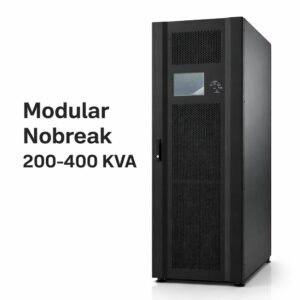
The compact form factor of HF technology has enabled the development of modular UPS architectures — systems built from hot-swappable power modules that can be added or removed while the UPS remains live. This is simply not practical with line-frequency transformer-based designs. For organisations that expect load growth or require N+1 redundancy without over-investment in initial capacity, modular HF UPS is the enabling technology. See our modular UPS range and our article comparing modular vs traditional UPS for growing businesses.
Rack-mounted deployments
For organisations that need UPS protection at the rack level — individual server racks, network equipment rooms, edge computing installations — rack-mount UPS systems are only practical with HF technology. A 10 kVA rack-mount LF UPS would weigh several hundred kilograms and occupy most of a standard rack. The equivalent HF unit weighs under 30 kg and occupies 2–4U. View our 19-inch rack-mount UPS options.
Energy-conscious and green building projects
When an organisation has sustainability commitments, energy reporting obligations, or is pursuing green building certification, the higher efficiency and near-unity input power factor of HF UPS contributes measurably to energy KPIs. The reduced heat output also lowers cooling load in the UPS room, creating secondary savings on air conditioning. For more on reducing energy waste through smart power infrastructure, see our article on smarter power infrastructure.
Typical HF UPS applications
6. Which to Choose by Industry and Application
| Industry / Use Case | Recommended Type | Primary Reason |
|---|---|---|
| Factory automation / CNC | Low-Frequency | Motor inrush, reactive loads, surge tolerance |
| Hospital / medical imaging | Low-Frequency | Galvanic isolation, patient safety compliance |
| Oil, gas, and petrochemical | Low-Frequency | Long service life, field serviceability, harsh environments |
| Power utilities and substations | Low-Frequency | Reliability, isolation, compatibility with relay protection systems |
| Water / wastewater treatment | Low-Frequency | Pump motor loads, outdoor / humid environments |
| Data center (large scale) | High-Frequency | Efficiency, compact footprint, modular scalability |
| Server room / IT closet | High-Frequency | IT-matched load profile, rack options, efficiency |
| Telecom base stations | High-Frequency | Compact size, low weight, high efficiency |
| Commercial offices | High-Frequency | Lower cost, smaller footprint, adequate for IT loads |
| Mixed IT + light industrial | Assess load profile carefully | Motor loads present → LF; purely IT loads → HF |
🔗 For a direct comparison of industrial vs commercial applications, see our article: Industrial vs Commercial UPS Systems: Selecting the Right Uninterruptible Power Supply →
7. Total Cost of Ownership: A Realistic Comparison
Capital cost is the most visible cost — but rarely the most important one over a 10–15 year UPS lifespan. A complete TCO analysis should consider five components:
Capital cost
An LF UPS typically costs 15–30% more than a comparable HF UPS at the point of purchase. The transformer and more robust power components drive this premium. For a 100 kVA installation, this may represent a difference of $5,000–$15,000 depending on the specific products.
Energy cost
A 4% efficiency advantage on a 100 kVA UPS running continuously translates to roughly $2,800–$4,200 per year in electricity savings (at $0.10–$0.15/kWh). Over 10 years, this easily offsets the capital cost difference in favour of HF — assuming an IT load profile where the efficiency advantage holds. For a deeper analysis of where efficiency losses occur, read our article on UPS system efficiency. Additionally, a power system audit can quickly reveal whether your current setup is costing you more than it should.
Maintenance cost
LF UPS systems have a longer service life (15–20 years vs 10–15 years for HF) and are generally easier to maintain due to simpler, more accessible components. Field technicians can replace capacitors, fans, and power modules individually. HF systems often require board-level or module-level replacement, which increases per-incident cost and dependence on manufacturer supply chains. For best practices, see our guide on UPS maintenance and commissioning.
Downtime and reliability cost
For industrial applications, an HF UPS that regularly transfers to bypass due to overload events is not just an inconvenience — it defeats the purpose of the UPS. The cost of a single unplanned production stoppage or equipment fault can exceed the entire purchase price of the UPS. Specifying the right type for the load profile is the most cost-effective risk mitigation available.
Installation and civil cost
The heavier weight of LF UPS may require reinforced flooring, heavier cabling, and more complex logistics. These costs are site-specific but should be factored into the installation budget, particularly for retrofits into existing buildings.
💡 The TCO conclusion
For pure IT and data center loads, HF UPS typically wins on TCO when energy savings are factored in over 10 years. For industrial applications with reactive and surge loads, the LF UPS wins on TCO through lower downtime risk, longer service life, and reduced maintenance cost — even despite its higher purchase price.
8. Decision Guide: 5 Questions to Ask Before You Choose
Work through these five questions to identify which technology fits your application:
Yes → Low-Frequency UPS. Motor inrush and reactive loads require the high overload tolerance only LF can reliably provide.
No → Either type is suitable on load grounds. Continue to Question 2.
Yes → Low-Frequency UPS (or HF UPS with an added isolation transformer, at added cost and complexity).
No → Continue to Question 3.
Yes → High-Frequency UPS. The compact form factor and rack availability of HF systems are decisive advantages.
No → Continue to Question 4.
Yes → Low-Frequency UPS. Longer service life, simpler components, and field-serviceability make LF the right choice for remote or demanding environments.
No → Continue to Question 5.
Yes → High-Frequency UPS. The 3–5% efficiency advantage compounds significantly over a 10-year operational period.
No / No strong preference → Either type can serve your application. Compare specific products on price, support, and lead time.
⚠️ The most common mistake: defaulting to HF because it’s cheaper
Many buyers choose a high-frequency UPS for an industrial application based on purchase price alone — without assessing the load profile. When the UPS is then exposed to motor inrush currents or downstream fault currents that exceed its overload rating, it transfers to bypass repeatedly, offers no protection during those events, and may sustain internal damage over time. Specifying the correct technology for the load is always more cost-effective than choosing the cheaper unit and managing the consequences.
Resumen
Low-frequency and high-frequency UPS systems are not competing products fighting for the same market — they are complementary technologies, each optimised for different electrical environments. The choice is not about which is “better” in isolation, but which is better matched to your load.
- Choose Low-Frequency when your load includes motors, reactive equipment, or large surge demands; when galvanic isolation is required; when the installation is in a harsh or remote environment; or when long service life and field serviceability are priorities.
- Choose High-Frequency when your load is predominantly IT and electronic; when space and weight are constrained; when you need rack-mounting or modular scalability; or when long-term energy efficiency is a primary objective.
When in doubt, a load assessment by an experienced power engineer will confirm the right specification — and prevent the far more costly mistake of choosing the wrong technology for your application.
Related articles
- Sistemas UPS industriales vs. comerciales: Cómo seleccionar el sistema de alimentación ininterrumpida adecuado
- UPS modulares vs. tradicionales: ventajas y desventajas para empresas en crecimiento
- Tecnología IGBT en sistemas UPS: el núcleo del sistema de alimentación ininterrumpida moderno
- Eficiencia de los sistemas UPS en aplicaciones de suministro de energía ininterrumpida
- Mantenimiento y puesta en marcha de SAI
Not Sure Which UPS Is Right for Your Application?
Our engineering team provides free technical consultations for B2B buyers. Share your load profile and application requirements — we’ll recommend the right technology and configuration.
Talk to an Engineer → ES
ES  EN
EN  ZH
ZH  ID
ID  VI
VI  MS
MS  PT
PT