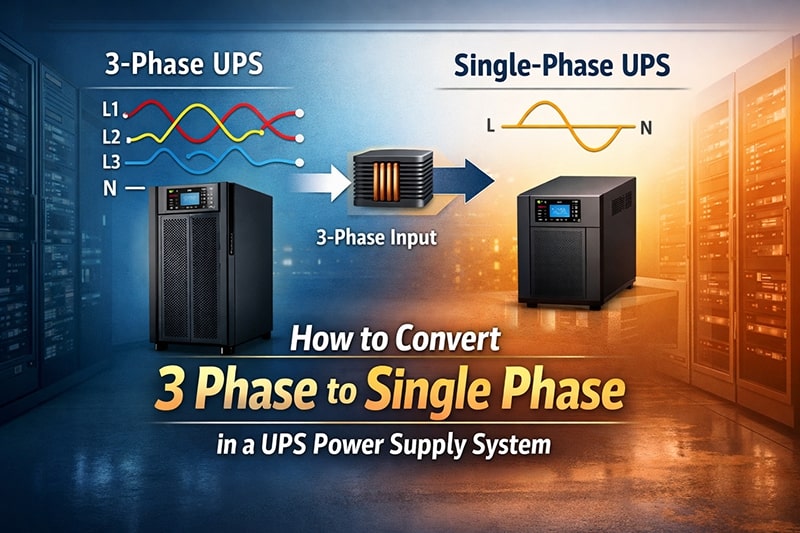
如何在UPS电源系统中将三相电转换为单相电

如何将三相电转换为单相电

Three-phase power systems are widely used in industrial, commercial, and mission-critical environments because they offer higher efficiency, better load distribution, and greater power capacity. As a result, many large uninterruptible power supply (UPS) systems are designed to operate with three-phase input power.

However, in certain scenarios—such as site power limitations, equipment changes, or load reductions—it becomes necessary to convert a three-phase UPS to operate from a single-phase power source. This article explains how such a conversion works, the technical considerations involved, and best practices to ensure safety and reliability.


Understanding 3-Phase and Single Phase UPS Systems

Three-Phase UPS Systems

A three-phase UPS uses three alternating voltage waveforms that are offset by 120 degrees. This configuration allows the system to deliver higher power levels with improved efficiency and reduced electrical stress on components. Three-phase UPS systems are commonly used in data centers, hospitals, factories, and other high-demand environments.

Single Phase UPS Systems

Single phase UPS systems provide power using one alternating waveform. They are typically used for smaller loads such as office equipment, networking devices, and light IT infrastructure. While simpler in design, single phase systems are limited in total capacity compared to three-phase solutions.


Why Convert a 3-Phase UPS to Single Phase?

There are several practical reasons for converting a three-phase UPS to single phase operation:

  • Limited site power: The facility only has single phase utility power available.
  • Load changes: The connected load has been reduced and no longer requires three-phase capacity.
  • Equipment compatibility: The protected equipment operates exclusively on single phase power.
  • System reuse: Repurposing an existing three-phase UPS for a smaller application.

It is important to note that not all three-phase UPS models support conversion. Manufacturer specifications must always be reviewed before proceeding.


Safety and Professional Requirements

Converting a three-phase UPS to single phase is not a do-it-yourself task. The process involves high voltages, complex power electronics, and strict electrical code requirements.

  • All work should be performed by qualified electrical professionals.
  • The UPS must be completely isolated from utility power and batteries before modification.
  • Local electrical codes and safety standards must be followed at all times.

How to Convert 3 Phase to Single Phase in a UPS

1. System Evaluation and Planning

Begin by assessing the total load that the UPS must support. Confirm that the required power level falls within the limits of single phase operation. Some three-phase UPS systems may need to be derated when operating on single phase input.

Next, consult the UPS manufacturer’s technical documentation to determine whether single phase input is supported and what configuration options are available.

2. Input Power Reconfiguration

In a three-phase UPS, the rectifier section is designed to accept power from three separate phases. To operate on single phase input, this section must be reconfigured. This may involve:

  • Rewiring the input terminals according to approved configurations
  • Installing jumpers or internal configuration settings
  • Using an external transformer to match voltage and current requirements

Directly combining multiple phases without proper design considerations is unsafe and can damage the UPS.

3. Transformer-Based Conversion

In many cases, a transformer is used as part of the conversion process. A single phase isolation or step-up/step-down transformer ensures the UPS receives the correct voltage and current while maintaining electrical stability. This approach also improves power quality and protects both the UPS and connected loads.

4. UPS Configuration and Control Settings

After hardware changes are completed, the UPS control system must be updated. This may include adjusting input settings, battery charging parameters, and alarm thresholds so the UPS correctly recognizes single phase input conditions.

5. Testing and Commissioning

Thorough testing is critical. The UPS should be tested under no-load and full-load conditions to verify voltage stability, thermal performance, and alarm behavior. Any abnormal readings must be corrected before placing the system into regular operation.


Key Challenges and Considerations

  • Reduced capacity: A three-phase UPS operating on single phase input may support lower total power output.
  • Thermal stress: Improper conversion can lead to overheating and reduced component life.
  • Warranty impact: Internal modifications may void the original manufacturer warranty.
  • Power quality: Harmonics and voltage instability must be carefully managed.

结论

Converting a three-phase UPS to single phase operation is a viable solution when site conditions or load requirements change. When performed correctly, it allows organizations to reuse existing UPS infrastructure while maintaining reliable, uninterrupted power.

Because of the technical complexity and safety risks involved, this conversion should always be planned and executed by qualified professionals, with careful attention to electrical standards, system ratings, and long-term reliability.

发表评论

您的邮箱地址不会被公开。 已用 * 标注

zh_CNZH
滚动至顶部