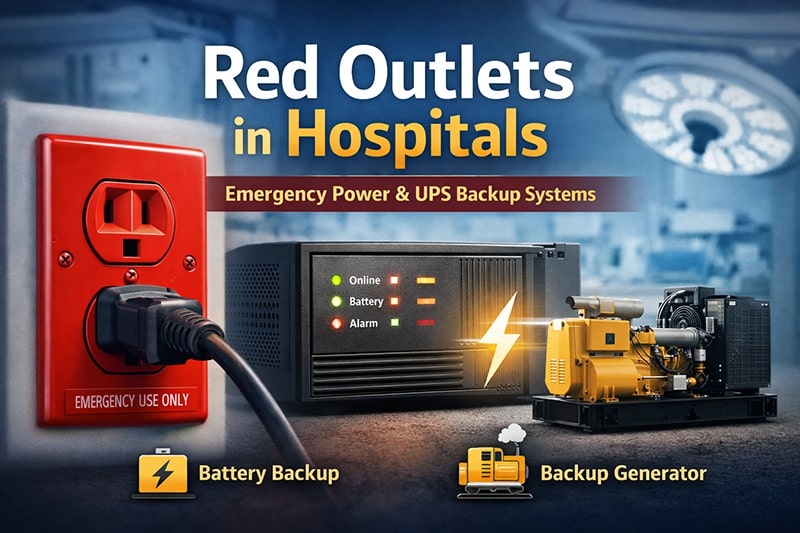
Red outlets in hospitals (sometimes called red sockets or emergency receptacles) are specially designated electrical outlets connected to a facility’s emergency power system. Their distinctive red color allows hospital staff to immediately identify which outlets will remain powered during a utility failure, ensuring that critical medical equipment continues operating without interruption.
Unlike standard wall outlets, red outlets are reserved exclusively for essential and life-supporting devices and form a core part of hospital electrical safety and reliability design.
Why Are Hospital Emergency Outlets Colored Red?
The red color serves as a clear and universal visual indicator in medical environments. It helps:
- Enable instant recognition during emergencies
- Clearly distinguish emergency circuits from normal utility power
- Prevent misuse by limiting access to critical equipment only
During power outages, natural disasters, or grid instability, medical staff must act quickly. Red outlets provide immediate confidence that connected equipment is supported by backup power.
How Red Outlets in Hospitals Are Powered
Red outlets are typically supplied by a layered emergency power system that combines both energy storage and energy production.
Battery Backup (Energy Storage)
Battery backup systems provide instant, uninterrupted power the moment utility power is lost. This immediate response is essential for lifesaving equipment that cannot tolerate even brief interruptions.
Backup Generators (Energy Production)
Hospitals commonly use propane, diesel, or natural gas generators connected through an automatic transfer switch (ATS). While generators provide long-duration emergency power, they require time to start and stabilize.
Depending on the facility and whether the generator starts automatically or manually, it can take anywhere from a few minutes to up to half an hour for generator power to become fully usable.
The Role of Uninterruptible Power Supply (UPS)
This transition delay is where the Uninterruptible Power Supply (UPS) becomes essential. A UPS fills the time gap between utility power loss and generator availability, delivering continuous power with no interruption.
For equipment connected to red outlets in hospitals, even a momentary power loss can lead to equipment shutdowns, data loss, or serious patient safety risks. A properly designed UPS ensures clean, stable, and uninterrupted power at all times.
Hospital Grade and Medical Grade Power Requirements
To be considered hospital grade or medical grade, backup power solutions must meet strict electrical performance standards. One key requirement is the ability to deliver pure sine wave power, which is necessary for sensitive medical electronics.
When a UPS is used in hospital environments, it is typically a double conversion (online) UPS system. In this design:
- Battery power is always engaged
- There is no millisecond-level transfer delay
- Output voltage and frequency remain stable
This distinguishes medical-grade UPS systems from consumer-grade or business-grade UPS units, which may have short transfer delays and are not suitable for critical healthcare applications.
Why Online UPS Systems Are Preferred in Hospitals
A secondary but equally important reason hospitals rely on online UPS systems is their ability to operate reliably on generator power. Generator output can be unstable during startup or load changes, and double conversion UPS systems continuously condition this power.
This ensures stable voltage, clean frequency, and protection against spikes or distortion—factors that are critical for maintaining safe operation of medical equipment.
Equipment Intended for Red Outlets
Red outlets in hospitals are reserved for essential systems, including:
- Ventilators and life-support equipment
- Patient monitoring systems
- Infusion pumps and anesthesia machines
- Nurse call and alarm systems
- Critical laboratory and diagnostic equipment
- Hospital IT and medical network infrastructure
Conclusion
Red outlets in hospitals are far more than color-coded sockets. They represent the visible endpoint of a carefully engineered emergency power pathway. Supported by battery backup, emergency generators, and medical-grade uninterruptible power supply (UPS) systems, red outlets ensure uninterrupted power delivery during outages, disasters, and grid instability—helping protect both patients and critical medical operations.
 EN
EN  ES
ES  ZH
ZH  ID
ID  VI
VI  MS
MS  PT
PT  UK
UK